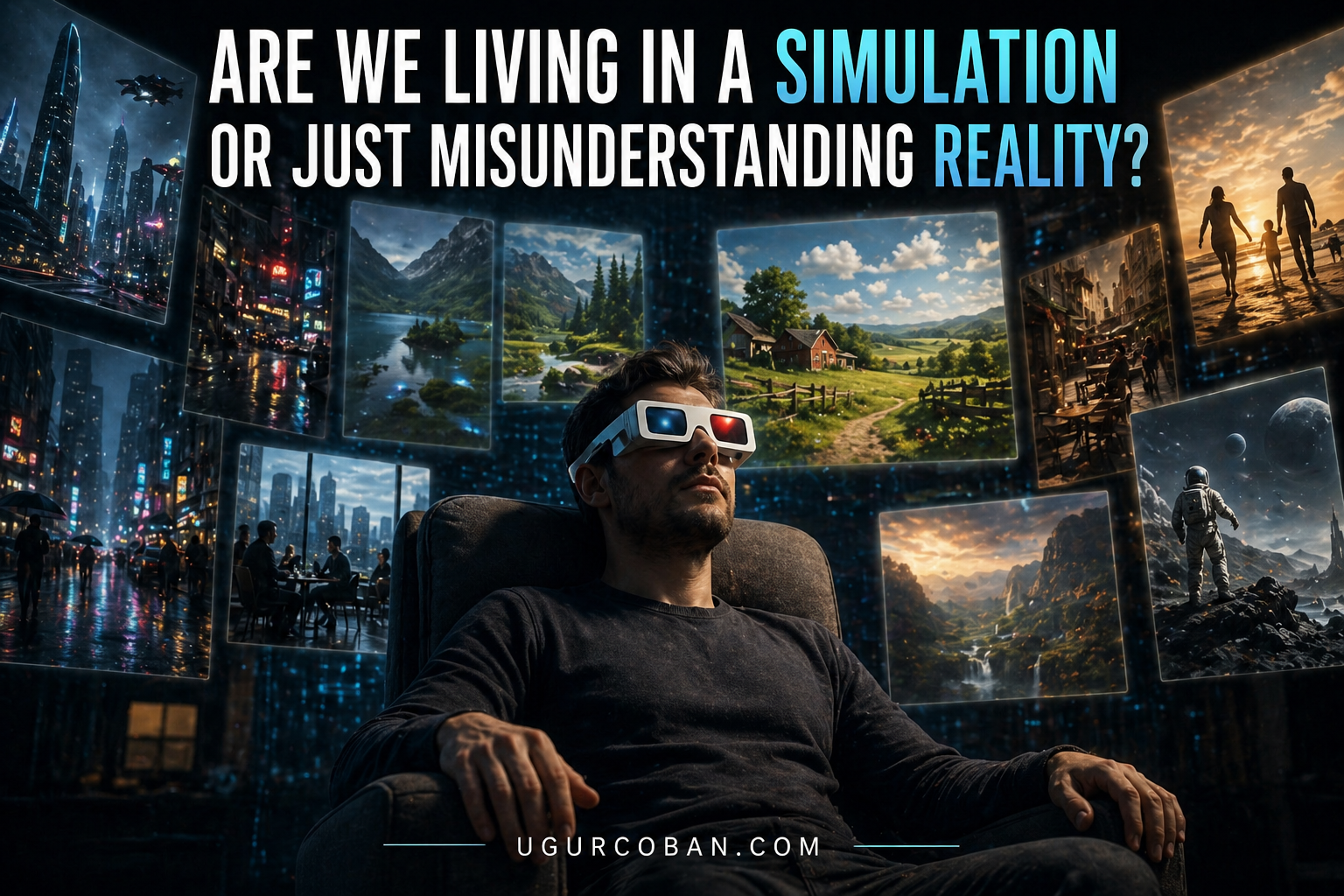
Are we living in a simulation, or is the brain already simulating reality so effectively that the difference no longer matters? This article explores the simulation hypothesis, predictive processing, and the limits of human perception to reveal how reality is constructed and why understanding this process is more valuable than proving what is real.
The question of whether we are living in a simulation has moved from science fiction into serious academic discussion. It is no longer just a thought experiment for philosophers or a plot device for movies. Advances in computing, artificial intelligence, and theoretical physics have made the idea more plausible than it once seemed. At the same time, neuroscience is revealing that what we perceive as reality is already a constructed model. This creates a fascinating intersection. Are we living in a simulation, or is the brain itself already simulating reality so effectively that the distinction becomes irrelevant?
To approach this question properly, we need to separate two layers of discussion. The first is external reality. This refers to whether the universe itself is fundamentally physical or computational in nature. The second is internal reality. This refers to how the brain constructs our experience of the world. These two layers are often mixed together, but they are not the same. Understanding both is essential before drawing any conclusions.
The simulation hypothesis, most famously formalized by philosopher Nick Bostrom, suggests a probabilistic argument rather than a direct claim. It states that if advanced civilizations can run detailed simulations of their ancestors, and if they choose to do so in large numbers, then simulated realities could vastly outnumber base realities. In that case, it becomes statistically more likely that we are in a simulation rather than in the original physical universe. This is not a claim that we are definitely in a simulation, but rather that the probability is non-trivial.
However, this argument depends on several assumptions. It assumes that civilizations reach a level of technological maturity where such simulations are possible. It assumes that they have the computational resources to run them. It also assumes that they have the motivation to simulate conscious beings. Each of these assumptions introduces uncertainty. The hypothesis is logically consistent, but it is not empirically verified.
At the same time, developments in physics have added another layer to the discussion. Some interpretations of quantum mechanics suggest that reality is not fully determined until it is observed. This has led to speculation that reality behaves like a computational system, where outcomes are resolved dynamically rather than pre-defined. While these ideas are often overstated in popular discussions, they do highlight that our understanding of reality at the fundamental level is incomplete.
“If our brains are fundamentally prediction machines, then reality as we experience it is already a controlled hallucination.”
Anil Seth
This perspective shifts the conversation significantly. Even if we are not in an external simulation, the brain is constantly constructing an internal one. Predictive processing suggests that perception is based on expectations corrected by sensory input. What we experience is not the world itself, but a model of it. This model is efficient and useful, but it is not a direct representation of objective reality.
From this point of view, the simulation hypothesis becomes less about external truth and more about internal experience. Whether the universe is simulated or not, our experience of it is mediated by the brain. This means that we are always interacting with a constructed version of reality. The difference between a simulated universe and a physical one becomes less obvious at the level of perception.
Another important factor is the role of information. Modern physics increasingly describes the universe in terms of information rather than matter. Concepts such as entropy, quantum states, and fields can all be understood as forms of information processing. This aligns with computational models of reality, where the universe operates like a system that evolves according to rules. However, describing something in informational terms does not necessarily mean it is literally a simulation. It may simply reflect the most effective way we currently have to model it.
“The universe is not only stranger than we imagine, it is stranger than we can imagine.”
J. B. S. Haldane
Haldane’s observation is particularly relevant here. Our intuitions about reality are shaped by everyday experience, not by the underlying structure of the universe. As a result, ideas like simulations can feel both plausible and absurd at the same time. They challenge the assumptions we rarely question, such as the nature of existence and the reliability of perception.
One of the strongest arguments against the simulation hypothesis is the lack of testability. If we are in a sufficiently advanced simulation, the system could be designed in a way that prevents us from detecting it. Any evidence we gather would also be part of the simulation. This creates a situation where the hypothesis cannot be confirmed or falsified using current methods. From a scientific perspective, this limits its usefulness.
However, some researchers have proposed indirect ways to test aspects of the hypothesis. For example, they suggest looking for limits in physical constants or anomalies in the structure of space-time that could indicate computational constraints. Others explore whether the laws of physics resemble optimization processes. While these approaches are intriguing, they have not produced definitive results.
On the other hand, the idea of misunderstanding reality is much more grounded in empirical research. Cognitive science has repeatedly shown that perception is influenced by expectations, context, and prior knowledge. Illusions, biases, and errors are not exceptions, they are built into the system. This suggests that the gap between perceived reality and objective reality is significant, even without invoking a simulation.
This brings us to a critical point. The simulation hypothesis and the predictive processing framework are not mutually exclusive. It is possible that both are true, or that neither is. More importantly, both highlight the same underlying issue. Our access to reality is indirect. We rely on models, whether they are generated by the brain or by a hypothetical external system.
“Reality is merely an illusion, albeit a very persistent one.”
Albert Einstein
Einstein’s statement captures the essence of this discussion. The persistence of the illusion makes it feel real, even if it is constructed. The question is not whether reality exists, but how accurately we can perceive it. This shifts the focus from metaphysics to epistemology, from what is real to what can be known.
Artificial intelligence adds another dimension to this conversation. AI systems can generate highly realistic simulations of images, text, and even environments. As these systems improve, the line between real and simulated content becomes increasingly blurred. This has practical implications for how we evaluate information and make decisions. It also raises philosophical questions about the nature of authenticity.
For example, consider how generative models create images. They do not copy reality, they generate it based on learned patterns. The output can be indistinguishable from real photographs, even though it has no direct connection to an actual scene. This mirrors how the brain constructs perception. Both systems rely on models rather than direct access to reality.
The concept of layers is useful here. There is the base layer, which may or may not be a simulation. There is the cognitive layer, where the brain constructs experience. And there is the cultural layer, where shared beliefs and narratives shape interpretation. Each layer influences the others, creating a complex system that defines how reality is experienced.
Understanding these layers has practical value. It can help us become more aware of biases, question assumptions, and evaluate information more critically. It can also inform how we design technologies that interact with human perception. By aligning systems with how the brain actually works, we can create more effective and ethical tools.
From a strategic perspective, the most important question is not whether we are in a simulation. It is how we should act given uncertainty. If reality is constructed, then understanding the construction process becomes a key advantage. It allows for better decision making, more accurate predictions, and greater adaptability.
This is particularly relevant in a data-driven world. As systems become more predictive, they influence behavior in subtle ways. Recommendations, personalization, and feedback loops shape what people see and how they act. Recognizing this influence is essential for maintaining autonomy and making informed choices.
At the same time, it is important to avoid extreme conclusions. The fact that perception is constructed does not mean that reality is arbitrary. There are constraints imposed by the external world, whether it is simulated or not. These constraints ensure that models remain grounded. The brain cannot simply invent any reality, it must align with input to remain functional.
The interplay between construction and constraint defines the human experience. It explains why perception is both reliable and fallible. It also explains why different individuals can have different interpretations of the same event. Each brain constructs its own model based on unique inputs and experiences.
Ultimately, the simulation hypothesis serves as a useful lens rather than a definitive answer. It encourages questioning assumptions and exploring the limits of knowledge. Whether or not we are in a simulation, the more immediate challenge is understanding how we perceive and interpret reality.
The real advantage does not come from knowing whether we are in a simulation, but from understanding how reality is constructed and how that construction influences behavior. This insight applies regardless of the underlying nature of the universe. It is actionable, measurable, and relevant to both individuals and organizations.
In conclusion, the question of simulation versus misunderstanding is not a binary choice. It is a spectrum of possibilities. On one end, reality may be exactly as it appears. On the other, it may be entirely constructed at multiple levels. Most likely, the truth lies somewhere in between. By focusing on how perception works, we gain a clearer understanding of both scenarios.