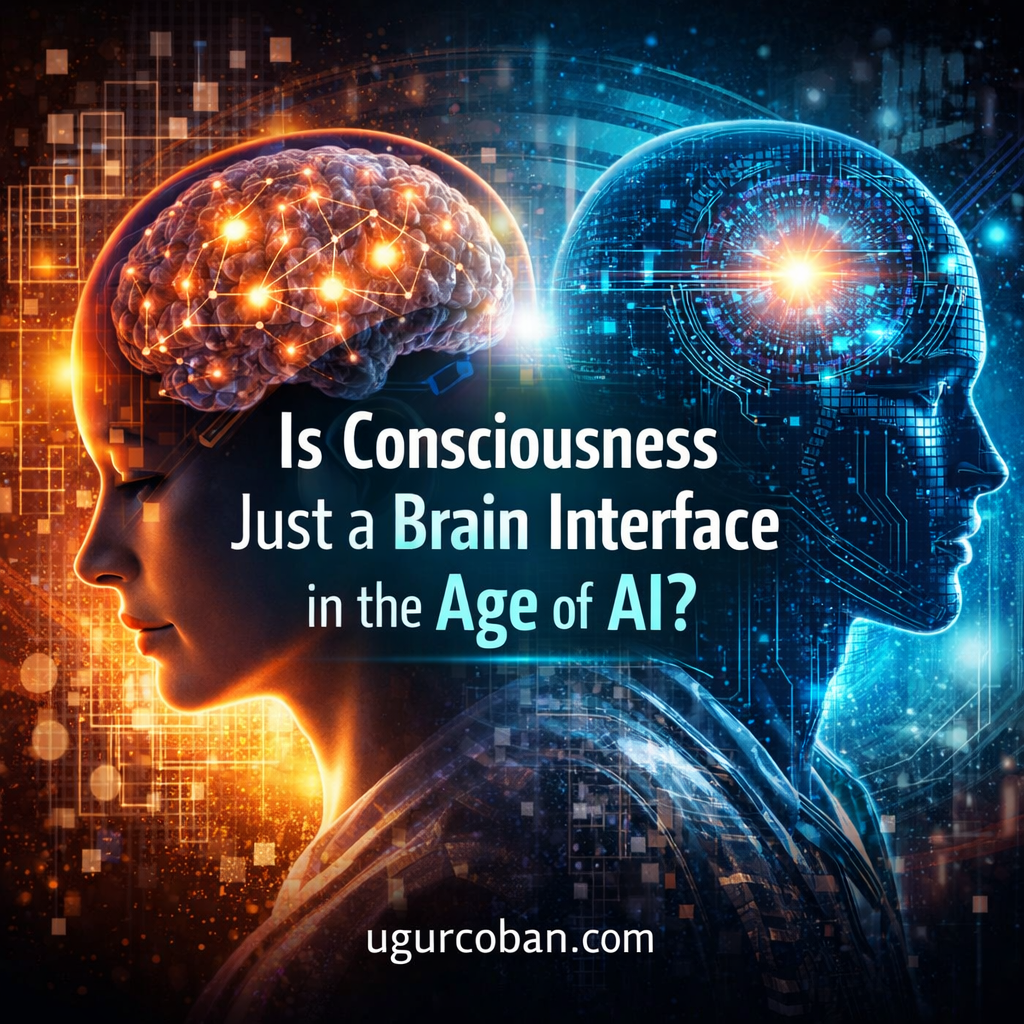
What if consciousness is not the core of who we are, but a functional interface built by the brain to simplify reality? This article explores how predictive processing, AI systems, and modern neuroscience challenge our assumptions about self, intelligence, and perception. As machines begin to mirror human cognition, the line between thinking and experiencing becomes increasingly blurred.
There is a quiet shift happening in how we understand ourselves. For centuries, humans placed consciousness at the center of existence and treated it as something almost sacred. Today, advances in neuroscience and artificial intelligence are pushing us toward a different possibility. What if consciousness is not the core of who we are, but rather an interface built by the brain? This question is no longer just philosophical, it is becoming a practical one in a world where machines increasingly mimic human cognition. If we take it seriously, it changes how we define identity, intelligence, and even reality itself.
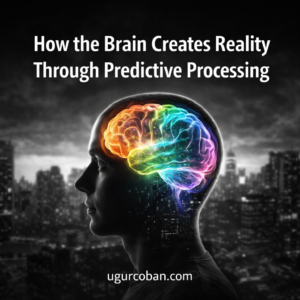
To begin with, we need to move away from the idea that perception is a passive process. Most people intuitively believe that they see the world as it is. In reality, the brain is not a camera, it is a prediction engine. It constantly generates expectations about the environment and then updates those expectations based on incoming sensory signals. This means that what we experience as reality is already filtered, shaped, and constructed before it reaches awareness. Consciousness, in this sense, is not the source of truth but the presentation layer of a deeper computational process.
This perspective becomes clearer when we consider how little raw data the brain actually receives. The eyes do not send complete images, they transmit fragments such as edges, motion, and contrast. The brain fills in the gaps using past experience and learned patterns. What you perceive as a stable, continuous world is actually a best guess generated in real time. Consciousness stitches these guesses together into a coherent narrative. Without this stitching process, experience would feel fragmented and chaotic.
The idea that consciousness is an interface suggests that it serves a functional purpose rather than a mystical one. Interfaces exist to simplify complexity and enable action. A computer desktop hides the underlying code and hardware processes, presenting icons and windows that are easier to interact with. In a similar way, consciousness may hide the complexity of neural activity and present a simplified version of reality that allows us to make decisions quickly. This simplification is not a flaw, it is a feature that increases survival efficiency.
If we accept this model, then the sense of self also becomes part of the interface. The feeling of being a single, unified “I” is not necessarily a reflection of an actual entity inside the brain. Instead, it may be a narrative construct that organizes experiences over time. This narrative creates continuity, giving us the impression that we are the same person from moment to moment. However, when examined closely, thoughts, emotions, and perceptions are constantly changing. The brain maintains stability by telling a consistent story, not by preserving a fixed identity.
Artificial intelligence provides an interesting mirror for this discussion. Modern AI systems process vast amounts of data and generate outputs that resemble human reasoning. They do not have consciousness in the human sense, yet they can perform tasks that once required it. This raises an uncomfortable question. If intelligent behavior can exist without subjective experience, then what exactly is consciousness adding? Is it essential for intelligence, or is it simply one way of organizing information processing?
The comparison becomes more compelling when we look at how both brains and AI systems rely on prediction. Machine learning models are trained to anticipate patterns and reduce error between prediction and reality. The human brain operates in a similar way, constantly minimizing prediction errors through perception and action. This similarity suggests that intelligence may not require consciousness at all. Instead, consciousness might be a byproduct of a particular type of predictive architecture.
One of the strongest arguments for consciousness as an interface comes from the phenomenon of illusion. Optical illusions demonstrate that perception is not a direct reflection of the external world. The brain prioritizes coherence over accuracy, often favoring interpretations that fit its internal models. When those models are tricked, the resulting experience feels real even if it is objectively incorrect. This shows that what we experience is not the world itself, but the brain’s interpretation of it.
The same principle applies to the sense of control and decision making. Experiments in neuroscience have shown that brain activity related to a decision can be detected before a person becomes aware of choosing. This suggests that the feeling of making a conscious decision may occur after the decision process has already started. Consciousness then constructs a narrative that explains the action, reinforcing the illusion of control. This does not mean that decisions are meaningless, but it challenges the idea that consciousness is the origin of them.
If consciousness is an interface, then it may also be limited by design. Interfaces prioritize usability over completeness, which means they necessarily hide information. There are countless processes in the brain that never reach awareness. These processes influence behavior, emotions, and perceptions without being consciously accessible. Consciousness presents only what is necessary for immediate action, leaving the rest in the background. This selective exposure shapes our understanding of ourselves and the world.
The implications for identity are profound. If the self is part of the interface, then it is not a fixed entity but a dynamic process. This process integrates memories, expectations, and current experiences into a coherent narrative. When any of these components change, the sense of self can shift as well. This explains why people can feel like different versions of themselves in different contexts. The underlying system remains the same, but the interface adapts to new inputs and goals.
In the context of artificial intelligence, this raises the possibility that consciousness could emerge if a system develops a similar interface. If an AI were to integrate information in a way that requires a unified representation for decision making, it might produce something analogous to consciousness. However, this would not necessarily mean it experiences the world in the same way humans do. The structure of the interface would determine the nature of the experience. Different architectures could lead to entirely different forms of awareness.
There is also a deeper philosophical question at play. If consciousness is an interface, then what is it interfacing with? One answer is that it connects the organism to its environment, translating complex signals into actionable information. Another possibility is that it mediates between different subsystems within the brain, coordinating their activity. In both cases, consciousness is not the foundation of reality but a tool for navigating it. This shifts the focus from what consciousness is to what it does.
Critics of this view argue that it does not fully explain subjective experience. Even if consciousness is an interface, there is still the question of why it feels like something to be aware. This is often referred to as the hard problem of consciousness. Explaining the function of consciousness does not automatically explain the existence of experience itself. This remains one of the biggest open questions in science and philosophy. The interface model addresses how consciousness works, but not necessarily why it exists.
Despite this limitation, the interface perspective has practical advantages. It aligns with current understanding in neuroscience and cognitive science. It also provides a framework for studying consciousness in a measurable way. By focusing on information processing, prediction, and integration, researchers can develop testable hypotheses. This moves the conversation from abstract speculation to empirical investigation. It also opens the door to comparing biological and artificial systems on common ground.
Another important implication is how this perspective affects our sense of meaning. If consciousness is an interface, then meaning is not something inherent in the world. Instead, it is constructed by the system interpreting the world. This does not make meaning less real, it simply changes its source. Meaning becomes a product of interaction between the brain and its environment. It is dynamic, context-dependent, and continuously updated.
In everyday life, this perspective can be both unsettling and liberating. It challenges the idea of a stable, central self that is in control of everything. At the same time, it reveals how flexible and adaptive the human mind is. If the self is a construct, then it can be reshaped. Habits, beliefs, and identities are not fixed, they are patterns that can change with new inputs and experiences. This creates space for growth and transformation.
The relationship between consciousness and reality also becomes more nuanced. If what we experience is a model rather than the world itself, then certainty becomes less absolute. Different individuals may construct slightly different models based on their experiences and expectations. This does not mean that reality is entirely subjective, but it highlights the role of interpretation. Understanding this can lead to greater openness and curiosity about other perspectives.
Artificial intelligence pushes these questions even further. As AI systems become more sophisticated, they challenge our assumptions about intelligence and awareness. If machines can perform complex tasks without consciousness, then consciousness may not be the defining feature of intelligence. Alternatively, if we eventually create systems that appear conscious, we will need to reconsider what consciousness really is. In both cases, the boundary between human and machine becomes less clear.
Ultimately, the idea that consciousness is a brain interface does not reduce its importance. Instead, it reframes it. Consciousness becomes a powerful tool that allows a biological system to navigate a complex world. It organizes information, creates a sense of self, and enables flexible decision making. It may not be the ultimate reality, but it is the lens through which reality is experienced. Understanding this lens is one of the most important challenges of our time.
If we take this perspective seriously, it changes how we think about ourselves in the age of AI. We are not separate from the systems we build, we are extensions of the same principles. Both brains and machines process information, make predictions, and act on the world. Consciousness may be one particular way this process manifests. Whether it is unique to humans or reproducible in machines remains an open question. What is clear is that exploring it will reshape our understanding of intelligence, identity, and reality for years to come.