What if reality is not something you see, but something your brain builds? This article explores predictive processing, showing how perception is shaped by expectations, emotion, and past experience. Understanding how the brain constructs reality reveals why we see the world differently and how AI systems mirror parts of this process.
There is a common assumption that we see the world as it is. It feels immediate, direct, and reliable. You open your eyes and the world simply appears. Objects are stable, colors are consistent, and space feels continuous. Yet modern neuroscience suggests something far more interesting. What we call reality is not directly perceived but actively constructed. The brain does not passively receive the world, it builds it.
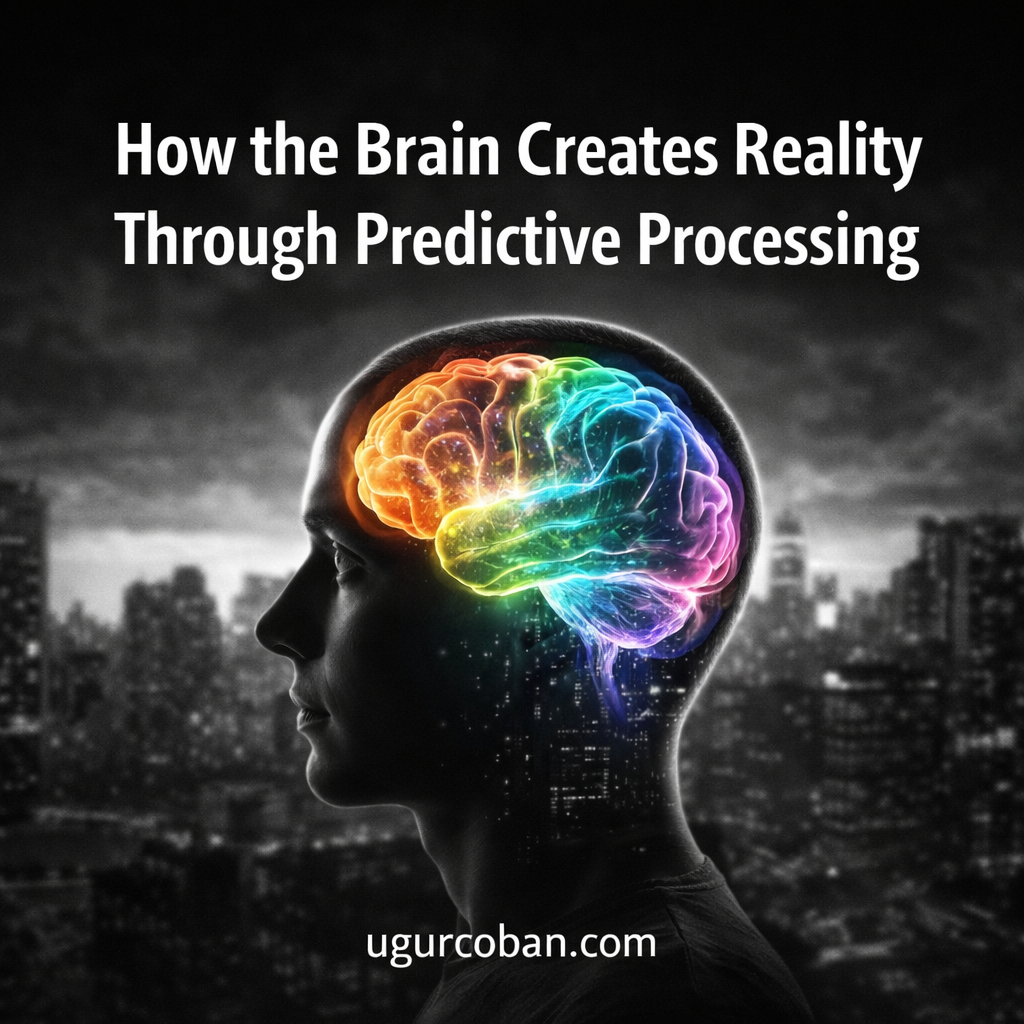
To understand this, we need to start with a simple but powerful idea. The brain is not a camera, it is a prediction engine. It continuously generates models of what it expects to perceive and then compares those models with incoming sensory data. This approach is known as predictive processing. Instead of starting from raw data and building up, the brain starts with expectations and corrects them. Perception becomes a process of minimizing error between what is predicted and what is sensed.
This changes how we think about experience. If perception is based on prediction, then what you see is not the external world itself. It is your brain’s best guess about the world. That guess is shaped by past experiences, learned patterns, and current context. Sensory input is still important, but it plays a smaller role than we might expect. It acts more like a feedback signal than a primary source of truth.
The implications are profound. It means that reality is not something you simply observe, but something you actively participate in creating. Every perception is a negotiation between expectation and input. When the prediction is strong and the input is weak, the brain leans toward its model. When the input is strong and unexpected, the brain updates its model. This dynamic process happens continuously, shaping everything you experience.
This idea is closely related to how human cognition operates at a broader level. The brain is constantly integrating information, forming patterns, and updating beliefs. Perception is just one part of a larger system that includes memory, emotion, and decision making. Understanding how the brain constructs reality helps explain why humans behave the way they do, and why two people can experience the same situation differently.
One of the clearest demonstrations of this process is found in visual illusions. Consider a simple example where two identical shades of gray appear different because of surrounding context. The brain interprets light and shadow based on its internal model of the world. It assumes that lighting conditions vary and adjusts perception accordingly. The result is an experience that feels real, even though it is objectively incorrect. This shows that perception prioritizes coherence over accuracy.
“Seeing is believing, but sometimes the most real things in the world are the things we cannot see.”
From the film The Polar Express
This quote captures something essential about perception. What feels real is not always what is objectively present. The brain fills gaps, smooths inconsistencies, and creates continuity. Without this process, the world would feel fragmented and unstable. Predictive processing is not a flaw, it is what makes perception usable.
The same mechanism applies beyond vision. Sound, touch, and even internal bodily sensations are shaped by prediction. When you hear a familiar voice in a noisy environment, your brain is using prior knowledge to fill in missing information. When you feel your phone vibrate even though it did not, your brain is generating a prediction based on expectation. These experiences reveal how perception is influenced by context and belief.
Emotion also plays a significant role in shaping perception. The brain does not treat all inputs equally. It prioritizes information that is relevant to survival and goals. Fear can make ambiguous stimuli appear threatening. Desire can make neutral objects seem appealing. These emotional influences are integrated into the predictive model, affecting what is perceived and how it is interpreted. Reality, in this sense, is colored by internal states.
“People think that reality is something objective and external, but in fact it is constructed by the brain.”
David Eagleman
Eagleman’s perspective aligns closely with predictive processing. The brain is constantly building a model that makes sense of the world. This model is efficient but not perfect. It simplifies complexity and allows for quick decision making. However, it also introduces biases and distortions. Understanding this trade-off is key to understanding human behavior.
Memory further complicates the picture. We often think of memory as a recording of past events. In reality, memory is reconstructive. Each time you recall an event, the brain rebuilds it based on current context and prior knowledge. This means that memories can change over time. They are influenced by expectations and beliefs, just like perception. The past, as you remember it, is also a constructed reality.
Time perception is another area where predictive processing is evident. The brain does not experience time as a simple sequence of moments. It integrates information over short intervals to create a sense of continuity. This allows for smoother perception but also introduces delays. What you experience as the present is actually slightly in the past. The brain compensates for this by predicting what is about to happen, creating the illusion of immediacy.
Language plays a subtle but powerful role in shaping reality. The words we use influence how we categorize and interpret experiences. Different languages emphasize different aspects of reality, leading to variations in perception. When you label something, you are not just describing it, you are shaping how it is understood. Language becomes part of the predictive model, guiding attention and interpretation.
This framework also helps explain why beliefs are so resistant to change. Once the brain has formed a strong model, it tends to favor information that confirms it. Contradictory evidence may be ignored or reinterpreted. This is known as confirmation bias, and it is a natural consequence of predictive processing. The brain seeks stability and coherence, even at the expense of accuracy. Changing beliefs requires updating the underlying model, which is not always easy.
The connection to artificial intelligence becomes clearer at this point. Many modern AI systems operate using similar principles. They generate predictions based on data and adjust those predictions based on feedback. While the architectures differ, the underlying idea of minimizing error is shared. This raises an interesting question about whether similar processes could lead to similar forms of perception.
In the context of what makes humans different from AI, the key distinction may lie in how these models are grounded. Human predictive models are shaped by embodied experience, emotion, and social interaction. They are deeply connected to a lived reality. AI models, on the other hand, are typically trained on data without direct experience. This difference influences how predictions are formed and how errors are interpreted.
The predictive nature of perception also has implications for decision making. Choices are influenced by how situations are perceived, and perception is shaped by predictions. This creates a feedback loop where expectations influence actions, and actions reinforce expectations. Understanding this loop can help explain patterns of behavior and how they change over time.
“Reality is merely an illusion, albeit a very persistent one.”
Albert Einstein
Einstein’s statement, while often quoted in different contexts, resonates with the idea of constructed perception. The illusion is not that reality does not exist, but that our experience of it is mediated by the brain. This mediation is necessary for functioning, but it also means that perception is not a direct window into the world.
Predictive processing also sheds light on mental health. Conditions such as anxiety and depression can be understood in terms of maladaptive predictions. The brain may overestimate threats or underestimate positive outcomes. These biases affect perception and behavior, reinforcing negative patterns. Interventions often aim to update these predictions, either through therapy or experience.
In practical terms, understanding predictive processing can change how we approach learning and decision making. By recognizing that perception is influenced by expectations, we can become more aware of biases. This awareness allows for more deliberate thinking and better adaptation to new information. It does not eliminate bias, but it creates space for reflection.
The concept also invites a different perspective on reality itself. Instead of seeing it as fixed and objective, we can see it as dynamic and constructed. This does not mean that anything goes, but it acknowledges the role of the observer. Reality is not just out there, it is also in here, shaped by the brain’s ongoing activity.
If the brain is constantly predicting reality, then perception is not about seeing what is, but about updating what we expect. This shift in perspective changes how we think about knowledge, truth, and experience. It emphasizes the importance of models and the need to refine them over time.
Ultimately, predictive processing offers a powerful framework for understanding the mind. It connects perception, memory, emotion, and decision making into a single system. It explains both the strengths and limitations of human cognition. Most importantly, it highlights the active role we play in shaping our own experience.