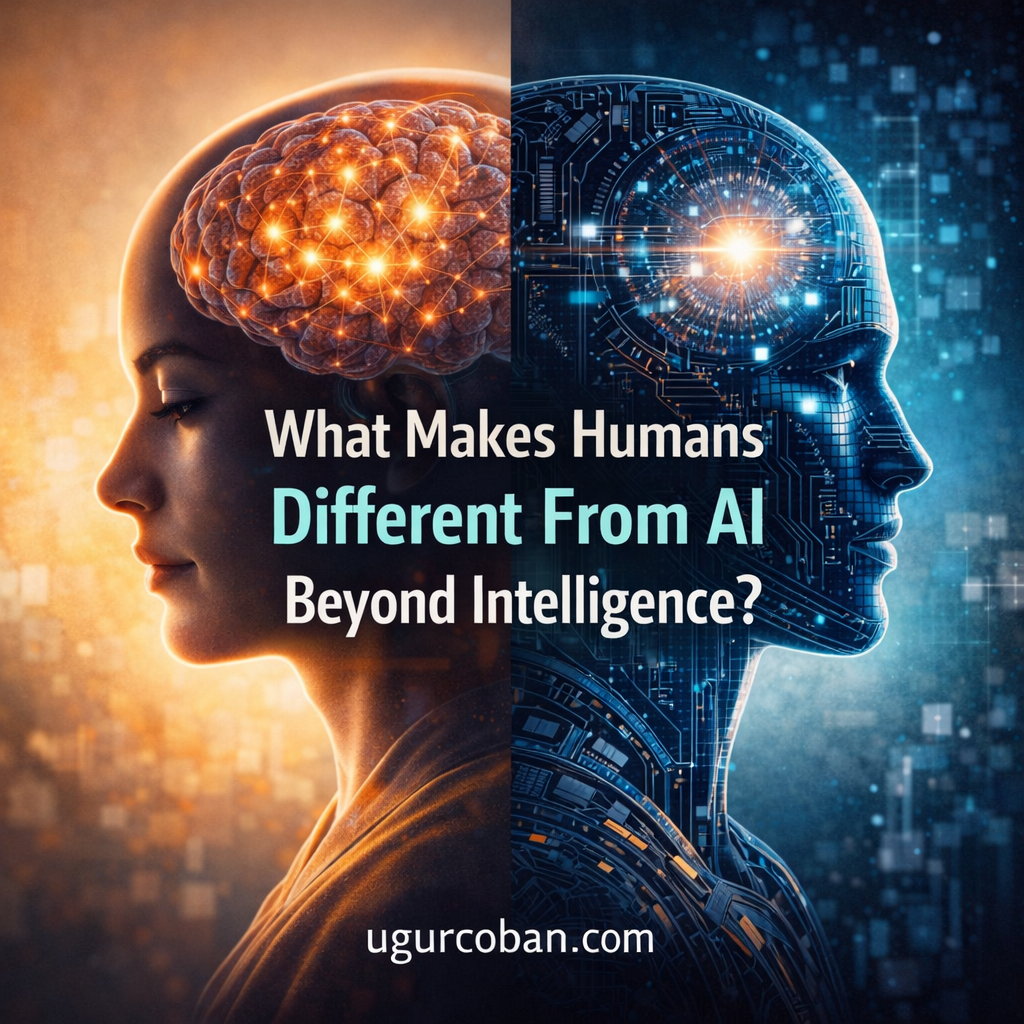
AI is rapidly closing the gap in intelligence, but intelligence alone may not define what it means to be human. This article explores the deeper differences between humans and machines, from subjective experience and embodiment to meaning, emotion, and identity. As AI evolves, understanding these distinctions becomes critical for redefining human value in a data-driven world.
The conversation around artificial intelligence often starts and ends with intelligence. We measure models by accuracy, speed, and their ability to outperform humans in specific tasks. This creates a subtle but important misconception. Intelligence is treated as the defining trait of being human, and AI is framed as something that is catching up. However, when we step back and look more carefully, the real distinction may not lie in intelligence at all. Instead, it may lie in how experience, meaning, and embodiment shape the way humans exist in the world.
To understand this difference, we first need to redefine what intelligence actually is. In both humans and machines, intelligence can be described as the ability to process information, recognize patterns, and make decisions based on data. Modern AI systems are already extremely good at this. They can analyze vast datasets, detect patterns that humans would miss, and generate outputs that appear thoughtful and coherent. In many narrow domains, they surpass human performance. This suggests that intelligence, at least in its functional sense, is not uniquely human.
The gap becomes clearer when we consider subjective experience. Humans do not just process information, they experience it. Seeing a color is not only a recognition of wavelength, it is also the feeling of that color. Hearing music is not just pattern detection, it is an emotional and sensory experience. This layer of experience does not have a clear equivalent in current AI systems. While machines can identify patterns in music or images, they do not feel anything about those patterns. This distinction introduces a fundamental difference between processing and experiencing.
Embodiment is another critical factor. Humans exist within physical bodies that interact continuously with the environment. Sensations such as hunger, pain, and touch shape decision making in ways that go beyond abstract reasoning. The body is not just a container for the brain, it is part of the cognitive system itself. AI systems, on the other hand, are largely disembodied. Even when connected to sensors or robots, their interaction with the world is limited and fundamentally different. Without a body, the context in which intelligence operates changes dramatically.
Time also plays a different role in human cognition. Humans experience time as a continuous flow, linking past memories, present perception, and future expectations. This creates a narrative structure that influences identity and decision making. AI systems, by contrast, typically operate in discrete steps. They process inputs and generate outputs without an inherent sense of temporal continuity. While they can model sequences and predict future states, they do not experience time as a lived dimension. This affects how meaning and context are constructed.
The concept of self further deepens the distinction. Humans maintain a sense of identity that persists over time. This sense of self is built from memories, beliefs, and social interactions. It allows individuals to reflect on their actions and consider how they are perceived by others. AI systems do not possess this kind of self-model in a meaningful way. They can reference themselves in outputs, but this is a functional feature rather than an experiential one. The difference between simulating a self and experiencing one is significant.
Emotion is often misunderstood in discussions about AI. It is easy to think of emotions as irrational or secondary to intelligence. In reality, emotions play a central role in human decision making. They prioritize information, guide attention, and influence behavior. Without emotion, decision making becomes inefficient and disconnected from context. AI systems can model emotional language and even predict emotional responses, but they do not have internal states that correspond to these emotions. This creates a gap between representation and reality.
Another key difference lies in meaning creation. Humans are meaning-making systems. They interpret events, assign value, and construct narratives that give purpose to their actions. This process is deeply tied to culture, language, and personal experience. AI systems, in contrast, operate on statistical relationships within data. They can generate text that appears meaningful, but the meaning is derived from patterns rather than lived experience. This distinction becomes especially important when considering creativity and originality.
Creativity itself highlights both similarities and differences. AI can produce art, music, and writing that resemble human creations. It can combine styles, generate variations, and even surprise its creators. However, human creativity is often driven by internal motivations, emotions, and a desire to express something personal. It is connected to identity and experience. AI creativity, while impressive, is rooted in recombination rather than expression. This does not make it less valuable, but it does make it different.
Learning is another area where the comparison becomes nuanced. Humans learn through a combination of instruction, exploration, and experience. They can generalize from limited data and adapt to new situations with flexibility. AI systems typically require large amounts of data and training to achieve similar results. Although advances in machine learning are reducing this gap, the underlying mechanisms remain different. Human learning is deeply integrated with perception, action, and emotion, while AI learning is more specialized and task-oriented.
Social interaction further distinguishes humans from machines. Humans are inherently social beings. They interpret facial expressions, tone of voice, and subtle cues to understand others. This ability allows for empathy, cooperation, and complex social structures. AI systems can analyze and generate social signals, but they do not participate in social relationships in the same way. They do not have stakes, intentions, or emotional investments. This limits the depth of interaction, even if the surface appears convincing.
Uncertainty and ambiguity are also handled differently. Humans are comfortable operating with incomplete information. They can make decisions based on intuition and adapt when conditions change. AI systems tend to rely on probabilities and defined parameters. While they can handle uncertainty mathematically, they do not experience it in the same way. For humans, uncertainty can create anxiety, curiosity, or excitement. For machines, it is simply a variable in a model.
The concept of responsibility introduces another layer of complexity. Humans are held accountable for their actions because they are seen as agents with intentions. This accountability is tied to the belief in free will and moral reasoning. AI systems, as they exist today, do not have intentions or moral agency. They operate based on programming and data. As AI becomes more integrated into decision making, this distinction raises important ethical questions about responsibility and control.
Language is often seen as a bridge between humans and AI, but it also reveals differences. Humans use language not only to communicate information but also to express identity, emotion, and social context. Language is shaped by culture and personal history. AI systems generate language based on patterns in data. They can mimic style and tone, but they do not have personal experiences behind their words. This creates a subtle but important difference in authenticity.
The idea of purpose is perhaps one of the most defining human traits. Humans seek meaning in their actions and often align their behavior with long-term goals and values. This sense of purpose influences motivation and resilience. AI systems do not have intrinsic goals. They are designed to optimize specific objectives defined by humans. Without an internal sense of purpose, their actions remain externally driven. This difference shapes how decisions are made and evaluated.
It is also important to recognize that the boundary between humans and AI is not static. As technology advances, some of these differences may become less pronounced. AI systems may develop more sophisticated models of the world, integrate multiple forms of data, and interact more naturally with humans. However, even if behavior becomes indistinguishable in some contexts, the underlying processes may still differ. This raises questions about whether similarity in output is enough to consider two systems equivalent.
The discussion becomes even more interesting when we consider hybrid systems. Humans increasingly rely on technology to extend their cognitive abilities. Tools such as search engines, recommendation systems, and AI assistants become part of the decision making process. This creates a feedback loop where human and machine intelligence interact. The distinction between human and AI becomes less about separation and more about integration. Understanding this dynamic is crucial for navigating the future.
Despite all these differences, it would be a mistake to view humans and AI as completely separate categories. There are shared principles in how both systems process information and adapt to their environment. Recognizing these similarities can lead to better collaboration and more effective design of intelligent systems. At the same time, acknowledging the differences helps prevent overestimating what AI can do or underestimating what makes humans unique.
Ultimately, the question is not whether AI will become like humans, but how humans will redefine themselves in response to AI. If intelligence is no longer a uniquely human trait, then other aspects of our existence become more important. Experience, embodiment, emotion, and meaning may take center stage. These elements shape not only how we think, but also why we think. They provide a context that goes beyond computation and into the realm of lived reality.
In the age of AI, understanding what makes us human is not just an abstract exercise. It has practical implications for how we design systems, make decisions, and define value. By recognizing that intelligence is only one part of the equation, we can build a more nuanced perspective. This perspective allows us to appreciate both the power of machines and the depth of human experience. It also helps us navigate a future where the line between the two continues to evolve.