Tag: ga4

Getting Accurate Channel Attribution on Shopify Using GA4
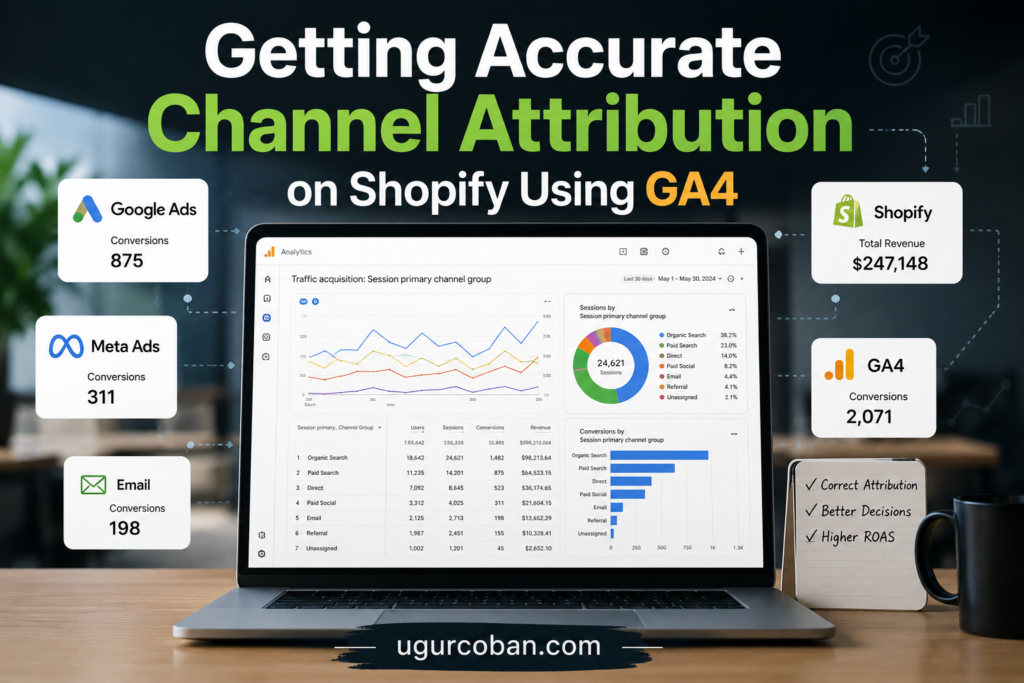
Laptop showing GA4 traffic acquisition and Shopify revenue dashboards with Google Ads, Meta Ads, email, and conversion attribution callouts, representing accurate channel attribution on Shopify using GA4 with ugurcoban.com branding.

Shopify Analytics files a large share of paid traffic as direct, hides upper-funnel contribution behind last-touch attribution, and discards the click identifiers that would reveal the true source. GA4 recovers most of this lost attribution automatically. This guide explains why GA4 outperforms Shopify for channel reporting and how to build a practice that uses each tool for what it measures well.

Why Your Ad Platform and Shopify Revenue Numbers Never Match

Comparison of revenue figures reported by Meta Ads, Google Ads, Google Analytics and Shopify showing attribution discrepancies across measurement platforms

Meta claims one revenue figure, Google claims another, and Shopify shows a third, all for the same time period. None of them are wrong. Each platform measures a different thing through different attribution logic, and the gaps between them are structural rather than fixable. This guide explains what each system actually counts and how to build a reporting framework that uses each for what it measures well.

The dataLayer: One Source, Every Channel

Glowing dataLayer database at the center connected to multiple digital marketing channels including analytics, social media, e-commerce, and communication platforms, illustrating unified data tracking architecture with ugurcoban.com branding

Most tracking setups fail not because of the wrong tools, but because of the wrong foundation. The dataLayer is the single object that makes GA4, Meta Conversions API, TikTok Events API, affiliate postbacks, and every server-side integration read from the same source of truth at the same moment. This guide breaks down what the dataLayer actually is, why tag management alone cannot replace it, and how a properly designed event schema eliminates the conversion discrepancies, deduplication failures, and optimization signal noise that silently corrupt multi-channel performance.