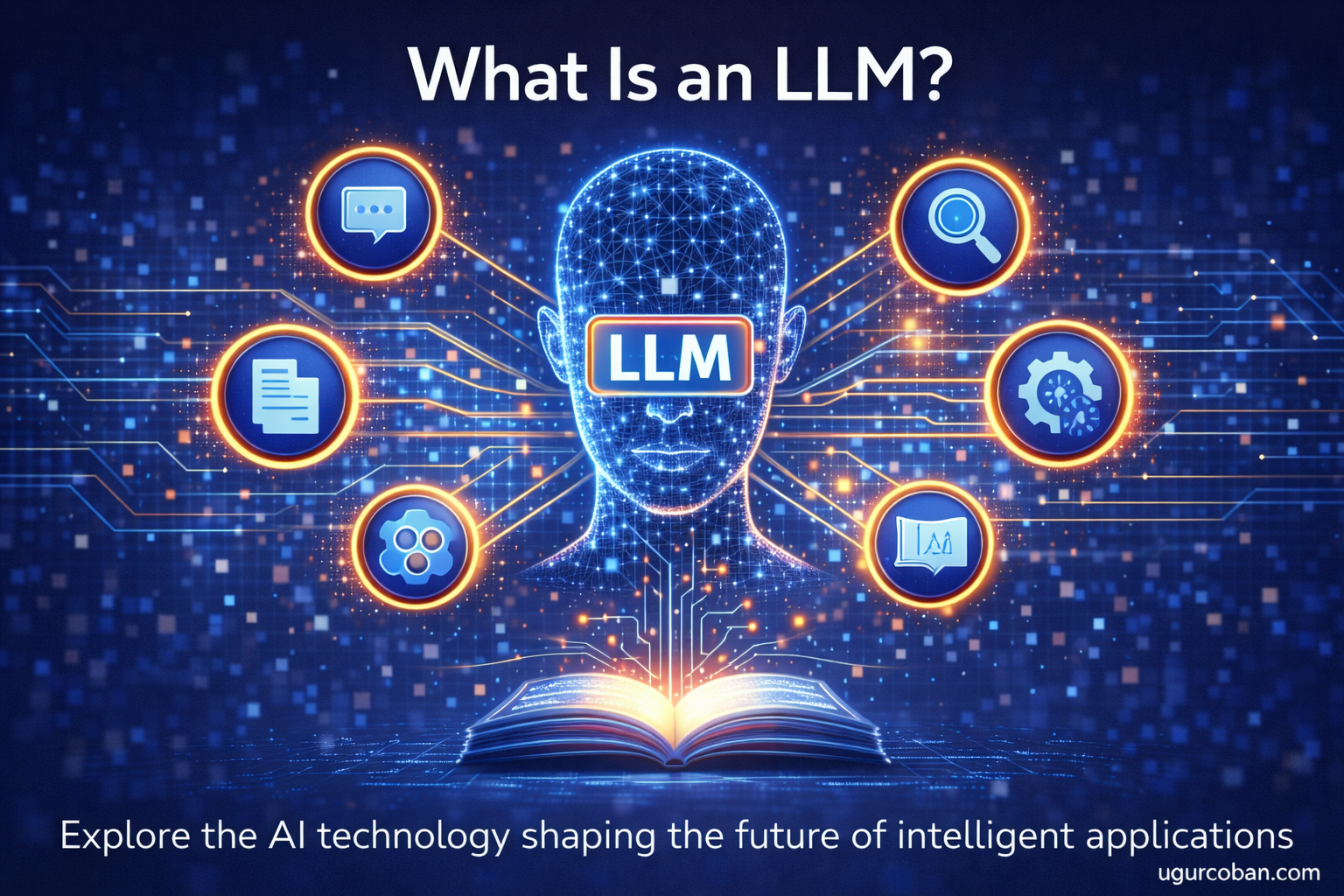
Large Language Models (LLMs) are transforming how we understand, generate, and act on data. This article explains what LLMs are, how they work, and why they matter for marketing, CRM, and customer intelligence in practice.
Artificial Intelligence has rapidly moved from theory to everyday business reality. At the center of this shift is a powerful concept that now shapes how we write, search, analyze data, and interact with technology: Large Language Models, commonly known as LLMs.
If you have used tools like ChatGPT, Claude, Gemini, or Copilot, you have already interacted with an LLM. But what exactly is an LLM, how does it work, and why is it fundamentally changing marketing, CRM, and data-driven decision-making?
This article provides a clear, practical introduction.
What Does LLM Stand For?
LLM stands for Large Language Model.
In simple terms, an LLM is an artificial intelligence model trained on massive amounts of text data to understand, generate, and reason with human language. Unlike traditional rule-based systems, LLMs do not rely on predefined instructions. Instead, they learn language patterns statistically by analyzing how words, phrases, and concepts relate to each other across billions of examples.
“Large” refers to both:
- The size of the training data
- The number of parameters (often billions) inside the model
How Do Large Language Models Work?
At their core, LLMs are probability engines.
Given a sequence of words, an LLM predicts what should come next, based on everything it has learned during training. This prediction happens token by token (a token can be a word or part of a word), using advanced mathematical representations of language.
Most modern LLMs are built on a Transformer architecture, which introduced a key innovation called attention.
The Attention Mechanism (Why LLMs Feel “Smart”)
Attention allows the model to:
- Understand context
- Weigh the importance of different words in a sentence
- Maintain coherence across long passages of text
For example, when reading a sentence about “customer lifetime value,” the model knows that “revenue,” “retention,” and “purchase frequency” are more relevant than unrelated terms. This contextual awareness is what makes LLM outputs feel structured and intentional rather than random.
What Makes LLMs Different from Traditional AI or Machine Learning?
Before LLMs, most machine learning systems were:
- Narrowly focused
- Heavily feature-engineered
- Trained for a single task (classification, prediction, clustering)
LLMs are fundamentally different:
| Traditional ML | LLMs |
|---|---|
| Task-specific | General-purpose |
| Structured data focused | Language and unstructured data |
| Requires manual feature design | Learns representations automatically |
| Limited context | Long-context understanding |
Instead of building separate models for search, copywriting, customer support, and analysis, a single LLM can perform all of these tasks, often with minimal configuration.
What Can LLMs Do in Practice?
LLMs are not limited to writing text. They act as language-based reasoning systems.
Common capabilities include:
- Writing and editing content
- Summarizing long documents
- Translating between languages
- Explaining complex concepts
- Writing and debugging code
- Extracting insights from unstructured data
- Holding contextual conversations
More importantly, LLMs can connect ideas across domains, which is why they are so valuable in business environments where data, communication, and decision-making intersect.
Why LLMs Matter for Marketing, CRM, and Customer Intelligence
For marketers and growth teams, LLMs represent a structural shift rather than a simple productivity tool.
1. From Static Segments to Dynamic Understanding
Traditional CRM systems rely on static attributes:
- Age
- Gender
- Location
- Past purchases
LLMs excel at interpreting behavioral signals:
- Searches
- Clicks
- Content consumption
- Messaging intent
- Session context
This enables a move toward event-based and intent-driven personalization, where communication adapts in real time rather than relying on outdated segments.
2. Content at Scale, Without Losing Context
LLMs allow teams to:
- Generate multiple content variants
- Maintain consistent tone of voice
- Adapt messaging to different stages of the customer journey
Instead of producing generic content, brands can create context-aware communication aligned with user intent, platform, and timing.
3. Turning Data into Language (and Language into Decisions)
Dashboards show numbers. LLMs explain why those numbers changed.
Examples:
- “Why did conversion drop last week?”
- “Which audience segment reacted best to this campaign?”
- “What patterns appear before churn?”
LLMs act as a translation layer between raw data and human decision-making.
Are LLMs the Same as Generative AI?
LLMs are a core component of Generative AI, but not the entire category.
- LLMs specialize in text and language reasoning
- Generative AI also includes image, video, audio, and code generation models
In practice, most Generative AI tools that involve text rely on LLMs as their underlying intelligence.
Limitations and Risks of LLMs
Despite their power, LLMs are not perfect.
Key limitations include:
- Hallucinations (confident but incorrect outputs)
- Lack of real-time knowledge unless connected to external data
- Sensitivity to prompt design
- Inconsistent reasoning on complex edge cases
This is why production systems often combine LLMs with:
- Deterministic rules
- Real-time databases
- Retrieval systems (RAG)
- Human oversight
LLMs are best seen as reasoning engines, not sources of absolute truth.
LLMs as a New Interface Layer
One of the most important shifts LLMs introduce is conceptual rather than technical.
LLMs are becoming a new interface layer between humans and systems:
- Instead of clicking dashboards, we ask questions
- Instead of writing SQL, we describe intent
- Instead of defining rigid workflows, we guide outcomes
This changes how software is designed, how teams work, and how decisions are made.
Final Thoughts
Large Language Models are not just another AI trend. They represent a foundational change in how we interact with information, systems, and customers.
For marketers, CRM leaders, and product teams, understanding LLMs is no longer optional. The competitive advantage will not come from simply using AI tools, but from knowing where and how LLMs create real leverage.
This article is the first step. In future posts, we’ll explore how LLMs integrate with CRM systems, how they enable personalization at scale, and how to design AI-driven customer intelligence architectures that actually work.