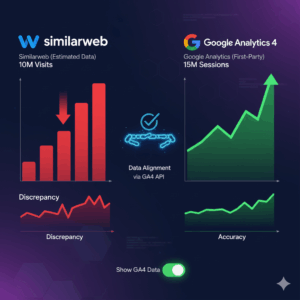
Most tracking setups fail not because of the wrong tools, but because of the wrong foundation. The dataLayer is the single object that makes GA4, Meta Conversions API, TikTok Events API, affiliate postbacks, and every server-side integration read from the same source of truth at the same moment. This guide breaks down what the dataLayer actually is, why tag management alone cannot replace it, and how a properly designed event schema eliminates the conversion discrepancies, deduplication failures, and optimization signal noise that silently corrupt multi-channel performance.
Every serious operator of a digital property eventually runs into the same crisis of confidence. The numbers in GA4 tell one story. The paid social dashboards tell another. The affiliate network reports tell a third. When you sit down to figure out which version is true, the instinct is to blame the platforms, the attribution windows, or the cookies. But the honest answer, in almost every case, is that the problem started much earlier. It started at the point where your website chose to communicate with your tracking tools in an inconsistent, unreliable, and structurally weak way. That choice has a name, and so does its solution. The dataLayer is the architectural decision that separates operators who run on real data from those who run on assumptions that have been formatted to look like data.
The stakes of getting this right have never been higher. Browser restrictions, consent requirements, and cross-device journeys have made the relatively forgiving era of pixel-and-cookie tracking a distant memory. Today, every major advertising platform has built a server-side API because it recognizes that browser-based signals alone are structurally incomplete. GA4 has redesigned its entire event model to reward behavioral depth over surface pageview counts. Affiliate networks are under increasing pressure from advertisers to prove attribution with verifiable order-level data. TikTok, Meta, and X are all running machine learning optimization models that train on the signals you send them, which means the quality of your tracking is now directly expressed as campaign performance. In this environment, a fragile and inconsistent tracking setup is not just an analytics problem. It is a competitive disadvantage that compounds every day you leave it unaddressed.
What the dataLayer Actually Is, and Why the Definition Changes Everything
The dataLayer is a JavaScript array that lives on your website and serves as a structured, standardized communication channel between your site’s application logic and your tag management system. It is not a product, a plugin, or a feature offered by any single platform. It is a convention, widely adopted and deeply important, that when implemented with care makes every downstream tracking system more reliable, more flexible, and more trustworthy. The simplest mental model is this: your website already knows everything that happens on it. It knows when a transaction completes, what the order value is, which products were purchased, whether the user was authenticated, and what content category triggered the session. Without the dataLayer, this knowledge is trapped inside application code, inaccessible to any external tool unless a developer writes a separate bespoke integration for each one. With the dataLayer, that knowledge is surfaced in a predictable, structured format that any tag, pixel, or analytics system can consume at the moment it becomes relevant. It transforms your website’s internal state from a closed system into an open, queryable data stream that every tracking destination can read from simultaneously.
The confusion most people carry about the dataLayer is the belief that a tag management system already solves this problem on its own. It does not. A tag management system is a deployment and triggering mechanism. It fires tags based on rules, manages script loading, and provides an accessible interface for creating tracking configurations without requiring a developer for every change. What it reads from is a separate concern entirely. Without a properly maintained dataLayer, a tag management system is forced to read data from unreliable sources: scraped DOM text, URL parameter parsing, cookie inspection, and element attribute reading. These approaches are brittle by nature. They break when a developer renames a CSS class, restructures a page layout, or changes the format of a URL. A well-designed dataLayer, by contrast, is intentional. It is data that a developer authored deliberately, surfaced for the explicit purpose of making it available to tracking systems. It does not break when the visual layer of the site changes because it exists separately from the visual layer. This separation is the foundation of every tracking setup that has ever held up at scale.
The dataLayer also introduces something that multi-channel tracking desperately needs but rarely gets without it: a single moment of truth. Without the dataLayer, different tags fire at different moments and read from different sources, producing subtly different versions of the same reality across every platform. With it, one dataLayer push captures the complete state of an event at one precise instant, and every tag that fires from that push reads identical values. The order ID is consistent. The revenue figure is consistent. The product details are consistent. Every downstream platform receives the same facts, formatted appropriately for its own requirements, because they all originated from the same authoritative source at the same moment. That consistency is what makes multi-platform measurement operationally tractable rather than a permanent reconciliation exercise.
Why Every Channel in Your Stack Depends on This Same Foundation
The modern tracking environment for a publisher or growth operator running multiple channels simultaneously is genuinely complex in a structural sense. GA4 requires behavioral events with specific parameters to build audiences and train predictive models. Meta’s Conversions API needs hashed personal identifiers, browser metadata, and transaction-level detail to perform customer matching and power its optimization algorithm. TikTok’s Events API needs that same quality of structured data to move beyond proxy signals and optimize against real business outcomes. X’s conversion system needs reliable event attribution across its own click infrastructure. Affiliate networks need order-level verification with clean IDs and revenue values that reconcile against your actual transaction database. Each of these systems wants essentially the same core information, but each has its own parameter naming convention, its own delivery mechanism, and its own interpretation of what constitutes a high-quality signal. The instinctive approach is to build each integration separately, one after another, each reading from its own source. The result is four different reported values for the same purchase event across four different platforms, and a monthly reconciliation process that exists not because reconciliation is possible but because people feel better doing it.
The dataLayer solves this by creating one authoritative moment that all downstream systems read from.
When a user completes a transaction, your application pushes a single structured dataLayer event containing everything that is true about that transaction: the order ID from your database, the revenue from your payment processor response, the currency, the full product detail, the user identifiers available at that moment, and any business-specific dimension your analytics architecture depends on. From that single push, every channel receives its version of the truth. GA4 reads the event parameters and maps them to the reporting dimensions you have configured. The Meta pixel and Conversions API both read the same event ID and transaction data, using a shared identifier to deduplicate the browser-side and server-side fires. TikTok’s server-side integration reads the same structured object and formats it for its own API. The affiliate postback reads the same order ID and revenue and delivers it to the network. The numbers align not because you reconciled them after the fact, but because they were born from the same source at the same moment. This is not a minor operational improvement. It is a structural transformation in how trustworthy your data environment is.
How GA4 Becomes a Genuinely Powerful Tool When Fed Proper Events
GA4 was designed around an event and parameter model rather than the session and pageview model of its predecessor, and this distinction carries enormous practical implications. The machine learning capabilities, audience builders, funnel analysis tools, and predictive scoring features within GA4 are not inherently valuable. They are as valuable as the event schema you feed them. A shallow implementation where only automatic events fire gives you surface metrics and very little structural intelligence about how your funnel actually works. A dataLayer-backed implementation where every meaningful user interaction pushes a structured event with relevant parameters gives you a measurement system that reflects how people actually navigate your property, where they drop off, what behaviors correlate with conversion, and who in your audience is exhibiting high purchase probability signals. The quality gap between these two implementations is not incremental. It is categorical, and it becomes more visible over time as the better-instrumented implementation compounds its analytical advantage.
Consider what a complete behavioral picture looks like inside GA4 when the dataLayer is doing its job properly. A content engagement session generates events with content type, category, author, scroll depth, and time-based engagement signals. A browsing session generates item list views, item detail views, and interaction events with specific filter or sort selections captured. A checkout journey generates step-by-step progression events with payment method selection, coupon usage, and abandonment points identifiable at each stage. A completed transaction generates a purchase event with the full item array, revenue, tax, shipping, and the transaction ID that ties back to your actual database. Each of these moments, because they arrived as structured and parameter-rich dataLayer pushes, becomes available as a dimension for segmentation, funnel construction, audience building, and the kind of predictive modeling that GA4 was actually designed to do. Custom dimensions mapped from dataLayer parameters let you analyze your data through the dimensions that matter to your specific business rather than the generic defaults GA4 ships with. This is what makes analytics a decision-making tool rather than a reporting ornament.
Meta, TikTok, X, and the Critical Role of Clean Signals in Paid Optimization
Paid social advertising is an optimization game, and the quality of your conversion signals is the primary input the algorithm uses to make decisions. This is not a metaphor or a simplification. When a platform’s delivery system decides which users to show your ads to and how much to bid for each impression, it is making probabilistic predictions based on the conversion events you have sent it over time. If those events are incomplete, inconsistent, or duplicated, the algorithm trains itself on noise, finds audiences that trigger your pixel without actually converting, and gradually drifts away from the users who were actually valuable to you. Browser-based pixels alone are increasingly insufficient to prevent this degradation because ad blockers, browser restrictions, and consent-related cookie loss mean a meaningful portion of real conversions never get reported back to the platform. The algorithm compensates for underreporting in ways you cannot observe directly but will pay for steadily through rising CPAs and eroding ROAS.
Server-side Conversions APIs exist precisely to close this gap, but they introduce a coordination requirement that only the dataLayer can fulfill cleanly. To run a browser-side pixel and a Conversions API simultaneously without double-counting, both must reference a unique event ID generated at the moment of the conversion. The platform receives both the browser-side and server-side signals, matches them on that shared event ID, and counts them as one event rather than two. If the event ID is absent, or if the two signals carry different IDs because they were generated separately by different parts of the stack, the platform counts them as two events and reported conversions inflate by whatever percentage of traffic sends both signals. Inflated conversion counts corrupt every downstream calculation: your reported ROAS becomes misleading, your optimization targets shift in response to phantom performance, and your campaigns begin behaving in ways that no amount of creative testing or budget adjustment will correct. The event ID must be generated once at the moment of conversion, pushed into the dataLayer, and read identically by both the browser tag and the server-side tag. This is a coordination problem. The dataLayer is the coordination mechanism. For TikTok and X, the same architectural logic applies in full.
The customer matching dimension is where the compounding value of a properly structured dataLayer becomes most visible in paid performance. When you pass hashed email addresses and phone numbers alongside conversion events, the platform matches those conversions to authenticated user profiles even when cookies would have failed entirely. This improves attribution accuracy, expands the pool of users available for lookalike modeling, and gives the optimization algorithm much stronger anchors to work from. But those hashed identifiers must be available to your tag management system at the moment the conversion fires. The only reliable way to make them available is to push them into the dataLayer from your application layer at the moment your site has access to them, typically at login or account creation, and then include them again in the conversion-level dataLayer push. An approach that tries to read identifiers from cookies or DOM elements will fail a significant percentage of the time and send partially complete signals that degrade match rates rather than improving them.
Affiliate Tracking: Where the dataLayer Becomes Your Financial Audit Trail
Affiliate tracking introduces a level of accountability that goes beyond standard analytics use cases and into the territory of financial verification and legal record-keeping. When a network records a commission-eligible conversion and your partner expects payment, you need the ability to confirm or dispute that conversion with documentary precision. This means your conversion events must carry reliable, database-verified order IDs, accurate revenue values sourced directly from your payment processor response, and a tested deduplication mechanism that prevents duplicate postbacks from firing when users refresh confirmation pages or navigate back through the browser. None of these requirements can be met by DOM scraping, URL parameter reading, or any approach that relies on what happens to be visible in the browser at a given moment. They require conversion data that originated in your application server, was verified against your database record, and was pushed into the dataLayer as a deliberate and intentional act at the exact moment the transaction was confirmed as complete.
A dataLayer-backed affiliate conversion event is a fundamentally different category of data from one assembled opportunistically from browser context. The order ID it carries was generated by your database and pushed to the dataLayer by your application. The revenue it reports came from your payment gateway’s transaction response, not from a price field scraped off a dynamically rendered page. The timestamp reflects when the transaction actually occurred in your system. If the user refreshes the confirmation page, the dataLayer push either does not fire a second time or fires with the same order ID, and your deduplication logic catches the duplicate postback before it reaches the network and triggers a duplicate commission. This transforms affiliate tracking from a liability, where disputed conversions are hard to verify and potentially expose you to systematic over-payment, into a clean, auditable record where every commission payout is backed by a structured, time-stamped, database-consistent event that you can reproduce and defend at any point. Higher-quality affiliate partners, the ones who drive real incremental revenue, require this level of attribution reliability before committing serious promotional effort to your offers. Your dataLayer architecture is part of what makes you a credible partner to them.
Building an Event Schema That Holds Up at Scale
A dataLayer implementation is exactly as good as the schema behind it, and a schema is exactly as durable as the documentation and governance processes that protect it. The schema is the agreed-upon specification that defines which events exist, what parameters each event carries, what data types and value formats are valid for each parameter, and who is responsible for maintaining and evolving it as the product changes. Without a documented schema, every developer who touches tracking-related code makes independent decisions. Event names drift across sections of the site. Parameter names become inconsistent between pages built by different people at different times. The same conceptual event ends up pushed with different structures in different contexts because no shared contract was ever established. The result is a dataLayer that appears to work but produces data that cannot be trusted at the parameter level, which is precisely the level where GA4, the Conversions APIs, and your affiliate postbacks depend on reading from it accurately.
The most effective event schemas adopt a tiered structure that mirrors the natural hierarchy of user intent and business value. At the baseline level, every page initialization pushes a context event with the page type, content category, and any user attributes available at that moment, so that every subsequent event on that page arrives already contextualized. At the interaction level, meaningful user actions push events with the parameters specific to that action and nothing extraneous. At the transaction level, any event with direct business value carries the full transactional context: order ID, revenue, currency, the product array with individual item detail, and all customer identifiers available at that stage. This tiered architecture means your analytics always has the context it needs, your paid platforms always receive the optimization signals they require, and your financial systems always have the verifiable, structured data they depend on. When you need to add a new tracking destination, whether a new ad platform, a new analytics tool, or a new affiliate network, you add a tag that reads from the existing schema rather than negotiating an entirely new data contract with your development team.
The schema is the long-term asset. The tags are just consumers of it.
Consistency in parameter naming is more consequential than it appears in planning conversations but becomes immediately obvious once production data starts flowing. If your revenue parameter is called value on some events, revenue on others, and transaction_total on a third set, every downstream system that depends on that parameter is reading structurally inconsistent data. Establish your naming conventions before the first line of tracking code is written, document them in a shared specification that lives in version control alongside your application code, and enforce them through code review the same way you would enforce any other engineering standard. Test every dataLayer push in your tag management system’s preview mode before it reaches production. Walk through every user journey in your funnel and confirm that the right events fire with the right parameters at every meaningful step. When a new product release goes out, that testing process is your quality gate. Tracking is not a set-it-and-forget-it implementation. It is a living system that requires the same maintenance discipline you apply to any other critical piece of your technical infrastructure.
Why the dataLayer Now Builds Long-Term Traffic Authority in the AI and GEO Era
The way content is discovered, evaluated, and cited has changed materially over the past two years, and the change is structural rather than cyclical. Generative search experiences and AI assistant interfaces are increasingly the primary point of contact between a user’s question and the content that answers it. These systems evaluate content differently from traditional keyword-based ranking algorithms. They favor depth, structural clarity, practical specificity, and the kind of authoritative precision that comes from genuine expertise rather than surface-level coverage assembled for ranking purposes. A piece of content that explains a technical concept with enough granularity to be operationally useful, that defines terms explicitly, that draws clear logical relationships between concepts, and that addresses the actual questions practitioners encounter in production environments is far more likely to be cited by a generative system than content that is broad, vague, or assembled primarily around keyword density targets.
Generative Engine Optimization, or GEO, is the emerging discipline of creating content structured to be accurately understood, correctly represented, and confidently cited by AI-powered search and discovery systems. The principles overlap significantly with good technical writing: write clearly, define your terms, organize information logically, and make the utility of each section explicit to the reader. But the execution requires a level of precision and topical specificity that goes beyond what was sufficient to perform well in traditional search. The dataLayer is a subject that fits this profile naturally. Surface-level coverage of it is abundant across the internet. Genuinely useful, architecturally complete, multi-channel guidance is rare. A publisher who produces thorough and accurate content on this subject at the level of specificity and practical utility that practitioners actually need is filling a real gap in the information landscape, and AI systems are increasingly capable of recognizing and rewarding that gap-filling through citation, recommendation, and sustained traffic.
There is also a compounding dynamic that makes investment in authoritative technical content particularly valuable over time. AI-mediated discovery tends to surface content to high-intent users: people who are actively building or improving systems, people with a specific problem they need to solve, people who engage deeply with content that actually helps them rather than content that merely appears to be relevant. These users generate behavioral signals, whether return visits, social sharing within professional communities, or inbound links from practitioner-authored content, that both traditional search systems and AI evaluation systems interpret as indicators of genuine topical authority. The content earns those signals through its actual utility rather than through optimization maneuvers, and those signals compound over time into a durable authority position that is difficult for less rigorous content to displace. The dataLayer is the foundation of your measurement infrastructure. Content that explains it with real depth is the foundation of your discovery infrastructure. Both rewards compound for the same underlying reason: precision and genuine usefulness are rare, and rarity, when it is useful, attracts sustained attention.